Jewish Humor(s)
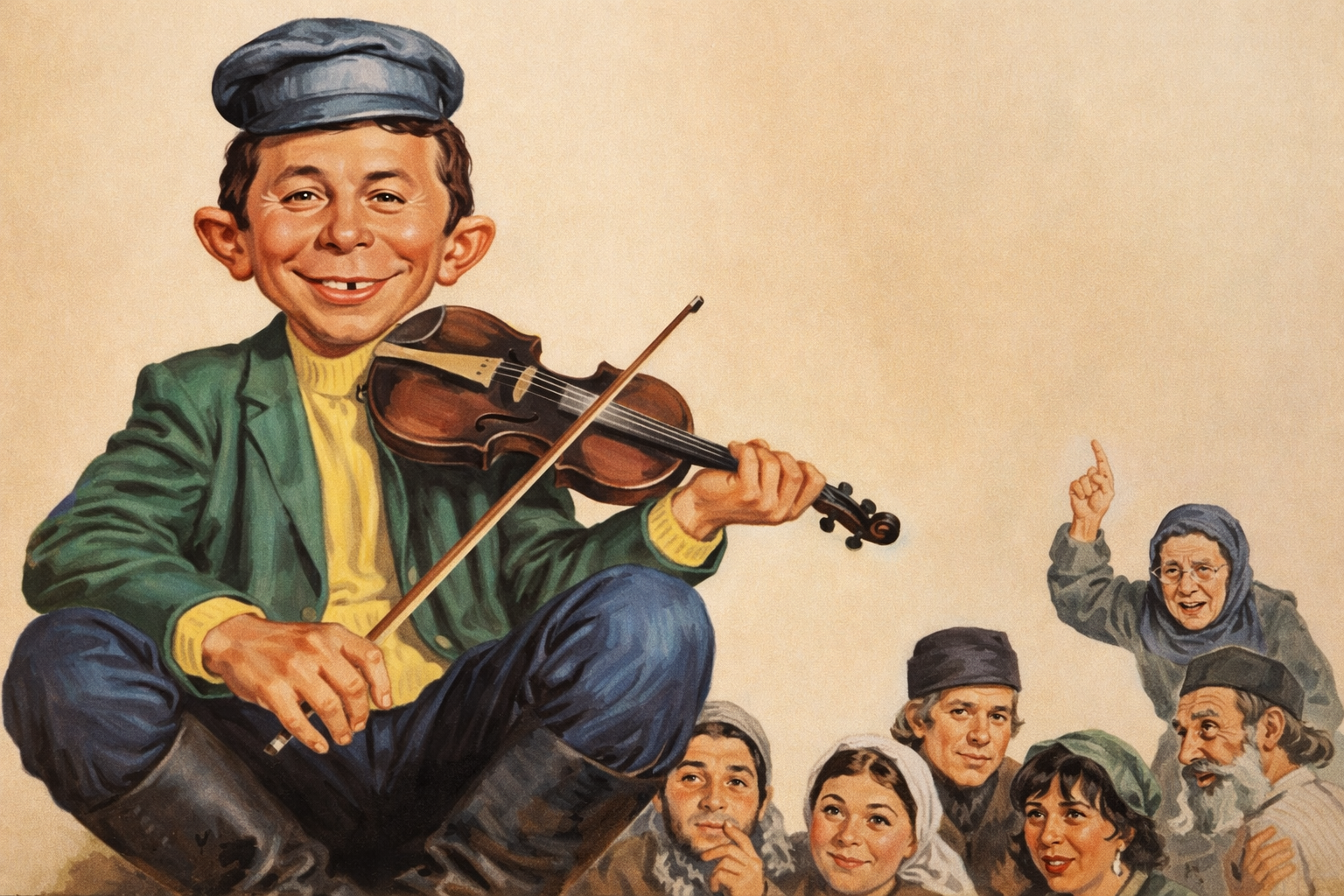
Mad Magazine, #33, published 1957.
The other night I was chatting up my friends about a Passover meme. A toddler wearing a tallis, spinning matzah like records (to “Can’t Touch This”) and gesturing toward loaves of challah as the reference. The joke being, of course, no bread during Passover. It was silly, recognizable, kind of delightful in the way those things are.
We laughed and bantered. Then, one of my friends paused and said he didn’t find it funny. Not in a harsh way, just honestly. He wondered if he’d been so inundated with this kind of Jewish humor that it no longer landed.
That stuck with me. I thought about the difference between what I think of as Jewish humor and what has become a kind of Jewish-coded humor. And the distinction isn’t about whether something is “allowed” or “authentic” or even funny. It’s about what the humor is doing.
Jewish humor, in its deeper tradition, has always carried weight. It comes out of contradiction. Of being inside and outside at the same time. Of navigating power, assimilation, marginality, survival. It often has an edge to it, even when it’s playful. There’s a point of view. There’s risk. There’s a kind of moral or intellectual tension underneath the joke.
Even when it’s absurd, it’s revealing something. When I think about the tradition I’m reaching for, I think about comedians like Lenny Bruce, Mel Brooks, Sarah Silverman, and Alex Edelman. They’re very different from each other, but what they share is that the joke is never just the joke. There’s always pressure underneath it. Bruce pushed at the boundaries of what could be said at all. Brooks used absurdity to collapse the authority of things that were meant to be untouchable. Silverman plays with discomfort in a way that implicates the audience. Edelman sits inside the tension of identity and lets it unfold rather than resolve. None of them relies on recognition alone. You don’t just “get it” and move on. You’re asked to sit with something, to notice something, to feel the edges of it.
That’s the difference. The humor isn’t just marking identity. It’s working on it. This is a tradition of humor that engages identity as something unstable, contested, and worth interrogating.
Then there’s another kind of humor. The Passover meme lives here. It’s built on recognition. You know what matzah is. You know the rules. You get the reference. The humor is in the shared understanding. This kind of humor isn’t trying to reveal anything new. It’s trying to say: you’re in this. You’re part of this. You get it. And that has value.
But it’s also annoying and irritating. “Matzah, no bread, Passover.” Once you get it, there’s nowhere else to go. There’s no turn, no tension, no surprise. So it can feel flat. Second, when you’ve grown up around humor that actually does something, questions authority, plays with contradiction, exposes something uncomfortable, then a meme that just signals “we’re Jewish, you get it” can feel like a downgrade. Not offensive, just…underwhelming. Third, there’s a kind of performative quality to it. It can feel like the point isn’t the joke, but the signal: “I’m in the know.” “I belong.” “I recognize this.” And once you notice that, it’s hard not to see the humor as trying to prove something instead of just being funny.
There’s also something about tone. A lot of these memes feel engineered to be broadly likable and easily shared. Which is fine, but it strips out the edge that makes humor feel alive.
And then, honestly, there’s fatigue. When you see the same structure over and over—holiday + food rule + wink—it starts to feel repetitive. Like hearing the same joke with slightly different props. It’s not engaging me. It’s not asking anything of us. It’s not revealing anything. It’s just… there.
And if you care about humor as a way of thinking, not just recognizing, that gap becomes really noticeable.
But it’s also worth thinking about. What does it mean that this is the humor we’re circulating? What does it say about us, the people making it and the people responding to it? These jokes are a way of finding each other quickly, without explanation. They create a low-barrier entry into identity. You don’t need to know history or theology or politics. You just need to recognize the reference.
There’s something generous in that. But there’s also something a little anxious. It’s a kind of soft signaling. On one hand, it can read as anti-assimilation. We’re naming ourselves. We’re marking difference. We’re saying, this is specific, this is ours. On the other hand, it’s often packaged in a way that’s widely legible, easily consumable, and socially safe. It translates quickly. It doesn’t challenge much. It doesn’t require much context. It fits neatly into the broader culture of shareable humor. And, if we’re being honest, there’s a bit of “cool kid” energy in it. The pleasure isn’t just in the joke, but in being someone who gets the joke. In being seen as in-the-know, culturally fluent, part of the group.
None of this is inherently bad. Culture has always worked this way, through repetition, shorthand, shared references. But over time, if recognition becomes the primary mode, something flattens. Because recognition alone isn’t the same as insight. One invites you in. The other asks something of you.
What my friend was reacting to, I think, wasn’t that the meme wasn’t Jewish enough, or even that it wasn’t funny. It’s that it didn’t do much beyond signaling. It didn’t carry the tension or the perspective that makes Jewish humor feel alive. It’s the difference between joke that affirms identity and humor that interrogates it. Both have their place. Not everything needs to be sharp or layered or do heavy conceptual work. Sometimes you just want something light, something easy, something that reminds you you’re part of something shared.
Maybe when we circulate only the easy version, we lose something of the tradition that made Jewish humor distinct in the first place. The part that questions. That pushes. That turns things over. The part that doesn’t just say “you get it,” but asks, what is this, really? I think that’s the humor that lingers.