Brain Attack
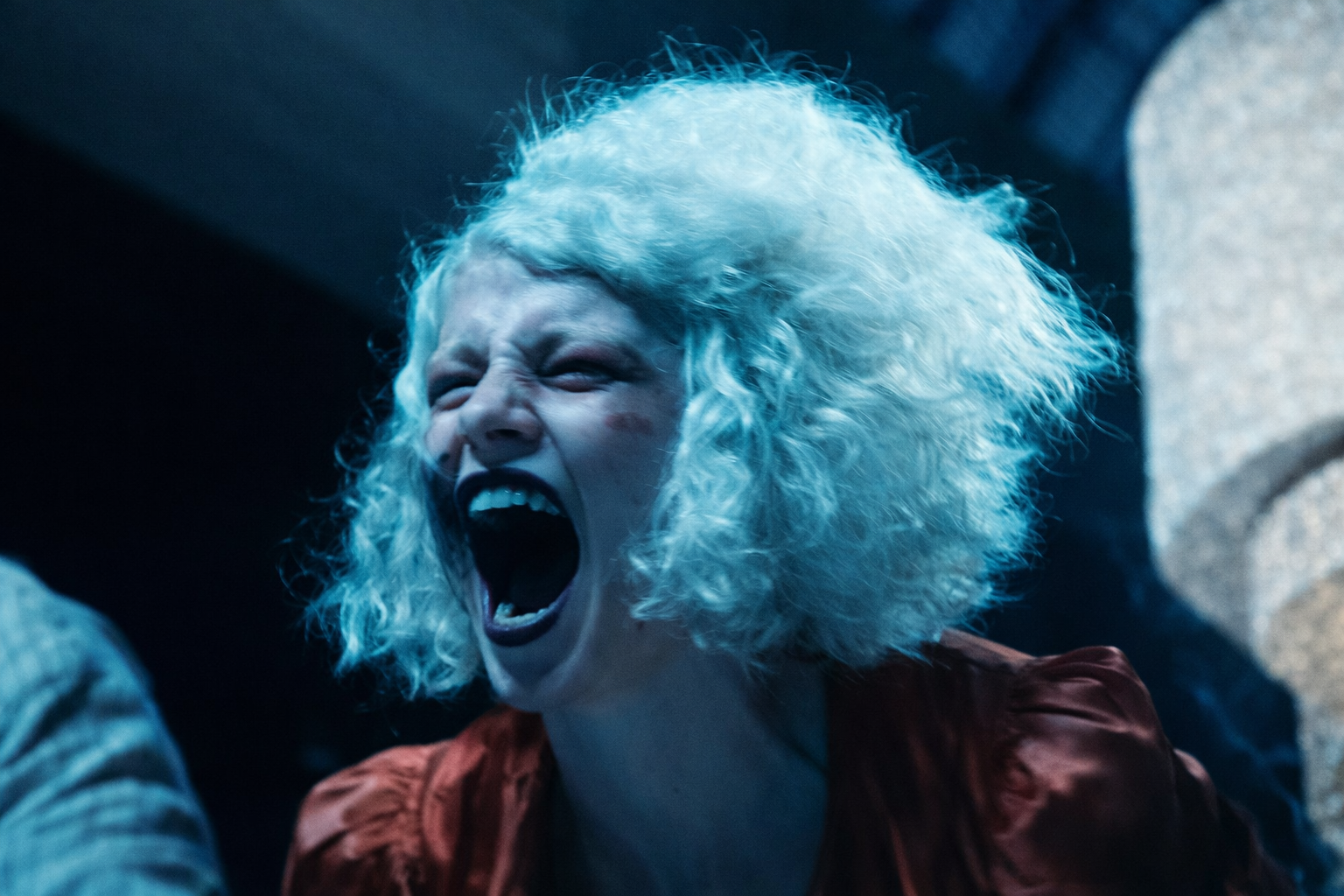
The Bride, Jessie Buckley, 2026
I walked out of The Bride a little stunned. Which felt strange for a film about women finding their voices… and everything that comes with that.
The discomfort I felt was in coming to terms with the reality that though the film was about voice, it wasn’t really about finding one clear, singular voice. It was about what happens when voice(s) are fractured, pulled in different directions, or don’t come together neatly at all.
And that’s where the movie starts making sense to me.
ABOUT
Maggie Gyllenhaal directs this revision of 1935’s The Bride of Frankenstein. In the original, Frankenstein’s bride appears for about three minutes, at the end of a 75-minute film. She’s introduced late, revealed, and then reacts. That’s essentially it. She has no spoken dialogue. Just a few nonverbal sounds: gasps, hisses, cries. She is literally made by men. She has no voice beyond reaction. Her identity is entirely relational, and she exists for the monster. Even though she refuses him, she doesn’t choose herself. She just reacts within a system she didn’t create.
She gets no story. She’s a symbol, not a subject.
In Gyllenhaal’s retelling, the Bride (played with an almost disorienting depth by Jessie Buckley) feels like a person. She has a point of view. A presence. She’s not a symbol. Not a solution.
And that feels right…because it’s 2026. But it also still feels radical.
It’s not that women today are voiceless. It’s that we move through communities and systems that (depending on who we are and how we’re perceived) pull our voices in different directions, until what we feel, want, or know can be hard to recognize as our own.
I’m not outside of that.
TENSION
Jessie Buckley plays three versions of the same woman. And three women. They’re split across names, identities, timelines. Polyrhythmic. Multisensory.
But what’s striking is this:
None of them try to be legible within the usual rules. They exist outside of that frame; outside the systems that shape women in ways that can make our own thoughts feel unfamiliar, even to ourselves.
Their rallying cry? “Brain attack!”
At first, it almost feels ridiculous. People in the theater laughed. But as I sat with it, it started to land differently.
Sure, it’s rupture or a break in the framework when everything that’s been held in (fear, courage, audacity, curiosity, contradiction, complexity) can’t be contained neatly anymore. But it’s not just breaking. It’s also a kind of re-forming.
When the Bride cries out “brain attack,” it doesn’t read to me as chaos. It reads like release. Like everything colliding at once, and finally having space to breathe. There’s patience for that collision. And something clarifying in that. Even a little bit of relief.
There’s a moment where the Bride realizes her story was constructed for her by Frank, by power, by expectation. And she rejects it. Not gracefully. Not politely. But completely. In response, she defiantly names herself. Not as a role defined in relation to someone else, but as something harder to categorize. Something that doesn’t need to be easily understood. She’s not interpretable on demand.
And that’s the point.
LANDING
When the credits rolled, my friends and I didn’t just think the film was good. We felt it hit something fundamental.
And it made sense that I didn’t have the words. Because the movie names a dynamic I hadn’t quite had language for: who gets to tell their own story, who gets to be coherent, and what coherence even means inside a culture that keeps us questioning ourselves.
I’ll see it again. But in the meantime, I saw parts of myself in the Bride. Not just in her anger, but in the buildup. The containment. The fragments. The feeling of having multiple voices and not always knowing how or whether to translate them, or even which one is supposed to count.
And maybe nothing is wrong with me for that. Because maybe coherence was never the goal.