Words and Reality
No. 8 | 2020
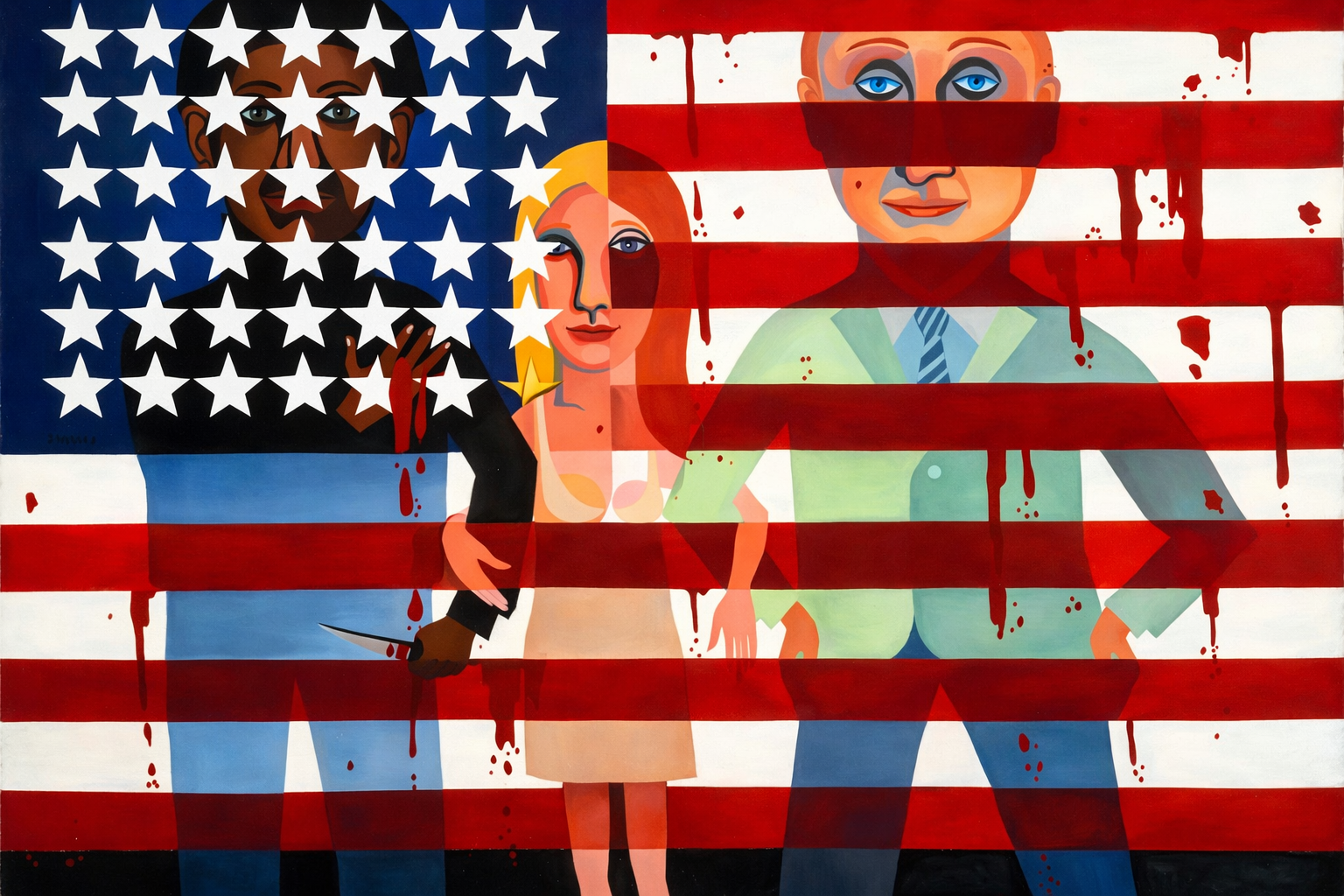
In 1963, Faith Ringgold began a series of 20 paintings called "The American People." She wanted to create images that would make people really look. "The more they look, the more they see," she says. Above, #18: The Flag Is Bleeding, 1967, oil on canvas.
Courtesy Faith Ringgold and ACA Galleries, New York
In recent weeks:
Mike Pence has bristled at what he calls Kamala Harris’s “presumption” that America is systemically racist.
Donald Trump has banned racial sensitivity training for federal contractors, calling such efforts “divisive” and “harmful.”
And members of the Senate questioned Supreme Court nominee Amy Coney Barrett about whether systemic racism even exists.
It’s hard to know where to begin.
Part of the problem, I think, is that racism is not one thing. And when we position it that way, it becomes easier to deny responsibility and harder to address what’s actually happening.
So, briefly:
Overt (or outright) racism refers to intentional, explicit acts or beliefs directed at individuals or groups because of race. It includes language or behavior that openly acknowledges racist attitudes and often draws directly from white supremacist ideology. These forms of racism are the easiest to recognize, condemn, and name.
Systemic racism refers to policies, practices, and norms that were once explicitly written into law and, though formally dismantled, continue to shape outcomes across generations. Even when legal language shifts toward “equality,” the effects persist.
Take redlining. Though now illegal, homes in historically redlined neighborhoods still appreciate at lower rates. Families who sell those homes walk away with less capital. Those neighborhoods tend to have lower tax bases, fewer school resources, and fewer opportunities—effects that compound over time.
Structural racism describes how systems reinforce one another. Housing affects education. Education affects employment. Employment affects health, wealth, and exposure to the criminal legal system. It functions less like a single policy than like a web—each strand connected to the next.
As Aleyasa Sewell explains, this can look like Black children being disproportionately placed in special education, becoming disengaged, being disciplined more harshly, and then criminalized as adults. Once marked, that status follows them—shaping access to housing, employment, and resources for life.
Institutional racism operates within specific institutions—banks, schools, healthcare systems—where access to resources is routinely distributed in ways that advantage white people. If systemic racism is the web, and structural racism its interlocking strands, institutional racism is the thread that runs through each node.
It can look like a Black college student being charged a higher interest rate than a white peer when purchasing a first car—leaving less money for tuition, more hours of work, and less time to study. Small differences accumulate. Outcomes diverge.
The effects are visible everywhere: in housing, education, health, food access, environmental exposure, and interactions with the criminal legal system.
In the United States, where Black people are disproportionately incarcerated and killed by police, the evidence of systemic racism is overwhelming. A 2020 Northeastern/Harvard study found that Black Americans are at greater risk of being killed by police, even though they are less likely to pose a threat. The Washington Post reports that Black Americans are killed by police at more than twice the rate of white Americans.
The same structures help explain why Black communities have been disproportionately impacted by COVID-19. As more than 1,200 health professionals wrote in an open letter in 2020, these disparities cannot be explained by biology. They are the result of long-standing systems of inequality—unequal access to care, unsafe working conditions, environmental exposure, and the cumulative toll of stress.
Words Matter
Sociolinguists point out that defining racism solely as individual prejudice allows everyone to condemn it, while avoiding the structural changes required to address it. Similarly, insisting that “anyone can be racist” obscures the specific role of power and history, and can even enable claims of white victimhood.
Taken to its extreme, the idea that naming race is itself “racist” makes it nearly impossible to talk honestly about institutional inequality at all.
That’s not accidental. And it’s not benign.
The language white people use to talk about racism has become a tool to stall progress. If we are serious about repair, we have to challenge colorblindness and false neutrality wherever they appear: in classrooms, community spaces, and the media. Without that challenge, the ideological foundations of racial inequality only grow stronger.
That reality is frustrating. And it’s also clarifying.
Bye for Now
Next post in two weeks.
SO. MUCH. LOVE.