Forgetting
No. 4 | (2021)
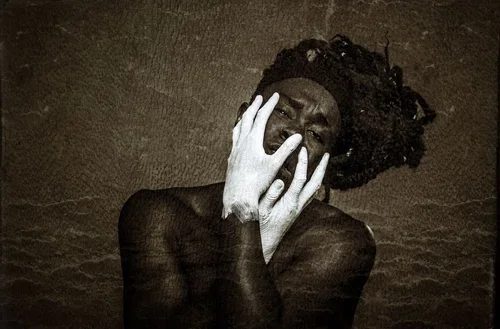
Photograph and Words by Jahi Chikwendu (2020).
“This is part of a series of photos meant to be a “Whitest Hands” version of Toni Morrison’s “The Bluest Eye.” In that book, Pecola Breedlove — a young black girl — is convinced that her life would right itself if only she had long, blond hair, white skin, and the bluest of eyes. This image is a startling alarm to wake us from internalizing the myth of white supremacy and the reality of racism, which has led us to blind, deafen, silence, even choke ourselves.”
Cultural Amnesia
In 2017, I flew back east for the Women’s March in Washington, D.C. Early that morning, the Mothers of the Movement stood on stage with Janelle Monáe. They led the crowd in a call-and-response to “Hell You Talmbout,” chanting the names of Sandra Bland, Natasha McKenna, Tanisha Anderson.
Then Monáe turned to the mothers.
“Say your baby’s name,” she said.
One by one, they did. Jordan Davis. Eric Garner. Trayvon Martin. Mohamed Bah. Dontre Hamilton.
I fell to my knees. I thought about my own sons. I told myself I would join the fight against police brutality.
And then I didn’t.
I moved on. I stopped watching. I let the feeling recede. I chose, quietly, to stand by.
I think about that now when people talk about what we should do next. I think about how easy it is, especially for white people, to feel something deeply and then let it fade. To treat each moment as if it has no history. To start over again and again.
That’s cultural amnesia. Not ignorance. Not cruelty. Just the quiet permission to forget.
If there’s a first step for me, it’s this: don’t forget when the moment passes. Don’t smooth over discomfort or explain it away. Stay long enough for it to change something.
Uncomfortable Truths
What do we do when our empathy turns out to be temporary? When our outrage comes and goes?
Jenna Wortham once asked whether white people are willing to sit with that question. Not only whether Black lives matter when they are taken, but how they matter when they are lived.
That question lingers.
So do the facts.
From 2013 to 2017, white patients in the United States received better health care than roughly 40 percent of Black, Hispanic, and Native American patients.
Black women are three to four times more likely to die from pregnancy-related causes than white women, even at similar income and education levels.
Black men receive sentences nearly 20 percent longer than white men convicted of the same crimes.
Black Americans are twice as likely to be unemployed and, when employed, earn about 25 percent less than white peers.
I don’t list these to win an argument. I list them because they are real. Because it’s easy to talk about feelings and harder to sit with structure.
Maps
For decades, people have been naming this.
Angela Davis has written about prison abolition since the 1960s, arguing that we criminalize poverty, addiction, homelessness, and mental illness. We respond to symptoms and leave the root untouched.
In 1976, the Prison Research Education Action Project outlined what they called an attrition model for abolition: moratorium, decarceration, excarceration.
Kwame Ture warned that race cannot be forgotten until its weight is reckoned with. Frederick Douglass reminded us that progress has never come without struggle. Audre Lorde wrote that survival is not theoretical. Roxane Gay, asked what to do about white friends who refuse to acknowledge privilege, answered plainly: get new friends.
None of this is new.
Witness
At the close of her performance that day, Monáe told the crowd, “We are watching.”
I’ve been thinking about what it means to watch.
To place the murders of Stephon Clark, Botham Jean, Breonna Taylor, Ahmaud Arbery, and George Floyd in a longer history. Against slavery. Alongside Emmett Till. In the shadow of the 16th Street Baptist Church bombing.
Witnessing in this sense is less about spectacle than it is about memory. It is context. It is refusing the comfort of distance.
For me, it means this: know the history. Live with what is uncomfortable. Remember, especially when it would be easier not to. And ask the people I love to do the same.
(Read more on witnessing and the public, unbearable grief of Black mothers.)
Bye for Now
Next post in two weeks.
In the meantime, email me at drcarala@gmail.com. Because…SO. MUCH. LOVE.